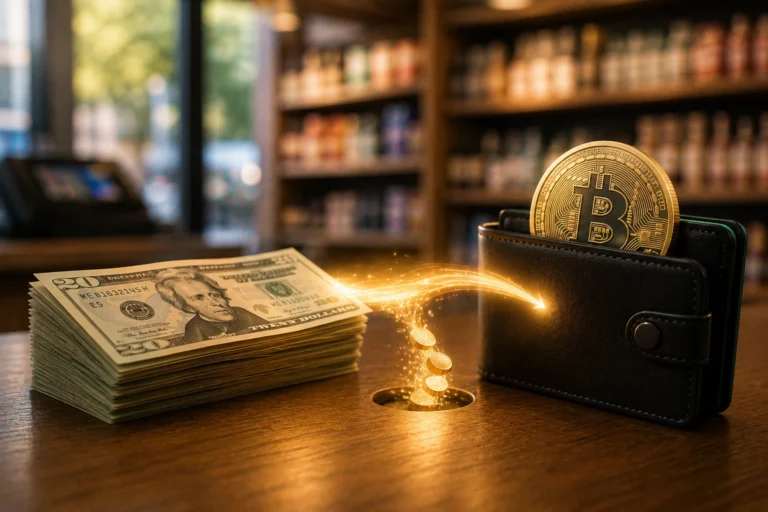
Crypto prices move fast. Bitcoin has dropped 30% in a matter of weeks, only to recover and reach new highs months later. If you’ve ever checked your wallet and felt your stomach drop (or felt a rush), you’ve experienced cryptocurrency volatility firsthand.
Understanding why crypto prices swing so dramatically can help you make smarter decisions about when and how you buy. This guide breaks down the causes of crypto volatility, the risks, and practical strategies for navigating price swings.
What is cryptocurrency volatility?
Volatility measures how much and how quickly the price of an asset changes over time. The more a price swings, the more volatile it is.
Bitcoin’s annualized volatility peaked in 2013, just four years after launch, when daily volatility averaged 7.58%. By the end of 2025, daily volatility had dropped to roughly 2.24%, the lowest on record, and actually lower than Nvidia stock during the same period. For context, Bitcoin’s annualized volatility sits around 54%, compared to about 15% for gold and 10.5% for global equities.
That declining trend matters. As more people and institutions buy and hold crypto through regulated channels like ETFs and licensed exchanges, the market has gradually become more stable, though still significantly more volatile than traditional assets.
What causes crypto prices to swing?
Several factors drive cryptocurrency price movements, often working together to amplify swings in either direction.
Factor | What it does | Recent example |
Market sentiment & social media | News, trends, and public mood trigger rapid buying or selling | The $1.5B Bybit hack in Feb 2025 accelerated Bitcoin’s decline from above $100K |
Liquidity | Low trading volume amplifies price moves from even modest orders | Bitcoin’s Nov 2025 dip occurred during a low-liquidity holiday weekend evening |
Regulation & government policy | New laws or enforcement actions shift confidence quickly | The GENIUS Act (July 2025) and SEC Chair Paul Atkins’ confirmation (April 2025) boosted prices |
Macroeconomic conditions | Interest rates, inflation, and Fed policy shape how people approach crypto | The shift from a peak fed funds rate of 5.5% (mid-2023) to gradual cuts through 2025 helped set the stage for Bitcoin’s run above $126K |
Limited supply, growing demand | ~95% of Bitcoin is mined; an estimated 3 to 4M BTC are permanently lost, leaving roughly 16 to 17M effective supply | ETFs and institutions accumulated significant BTC holdings in 2025, tightening available supply |
What risks does volatility create?
Rapid price drops: The value of crypto in your wallet can decline significantly in a short period. Bitcoin dropped roughly 50% from its October 2025 all-time high of ~$126K to early 2026 lows in the low $60,000s.If you needed to sell during that window, you would have locked in a substantial loss.
Market manipulation: Crypto markets, particularly for smaller tokens, remain vulnerable to pump-and-dump schemes, wash trading, and social media manipulation that can distort what’s actually happening in a market.
Difficulty selling during downturns: During sharp sell-offs, order books thin out as buyers step away, meaning you could receive less than the displayed price, a concept called slippage. This is more common with smaller cryptocurrencies and less-established exchanges.
How to navigate crypto volatility as a buyer
Volatility isn’t something you need to eliminate. It’s something you can plan around.
Strategy | How it works | Best for |
Dollar-cost averaging (DCA) | Buy a fixed dollar amount on a regular schedule to smooth out your average price | Anyone making recurring purchases |
Diversification | Spread purchases across multiple cryptocurrencies to reduce single-coin risk | Buyers who want exposure beyond just Bitcoin |
Set a comfortable budget | Decide on a monthly amount you can afford to lose and stick to it | First-time buyers and anyone building a long-term position |
Stop-loss and limit orders | Automate sells at a set floor price, or buy only when the price hits your target | Active buyers managing holdings on exchanges |
Avoid panic decisions | Recognize that major drawdowns are historically normal and have preceded new highs | Anyone tempted to sell during a red week |
Dollar-cost averaging is how most people successfully build their crypto holdings over time. Consistency matters more than timing.
Diversification reduces the impact of any single coin’s price drop. Bitcoin and Ethereum tend to be less volatile than smaller altcoins, while stablecoins like USDC maintain a steady $1 peg. Through Coinme, you can buy Bitcoin, Ethereum, Litecoin, Solana, XRP, USDC, and more, all from the same wallet.
Setting a budget is the oldest piece of crypto advice and still the best: don’t buy more than you can afford to lose. Sticking to a monthly budget regardless of price action keeps you in control.
How are current trends affecting volatility?
Institutional adoption is stabilizing the market. The launch of spot Bitcoin ETFs in the U.S. in January 2024 fundamentally changed the market structure. ETF and institutional buyers accumulated substantial Bitcoin holdings in 2025. These buyers tend to hold through downturns rather than panic sell, which acts as a stabilizing force.
Stablecoin regulation adds clarity. The passage of the GENIUS Act in July 2025 created the first federal framework for stablecoins in the U.S. Clearer rules reduce uncertainty, which historically reduces volatility. For cash-to-crypto buyers, stablecoins like USDC offer a way to hold value in crypto without exposure to Bitcoin’s price swings.
AI and algorithmic trading now accounts for a significant share of crypto volume. These systems can both dampen volatility (by providing constant liquidity) and amplify it (by triggering cascade sell-offs when pre-set thresholds are hit). The net effect is that short-term price moves happen faster, but recovery also tends to be quicker.
Tools for tracking crypto volatility
The Bitcoin Volatility Index (available at bitbo.io) tracks the standard deviation of Bitcoin’s daily returns over 30- and 60-day windows. The Crypto Volatility Index (CVI) offers a broader measure across multiple cryptocurrencies. For more granular analysis, platforms like TradingView provide moving averages, RSI, and other technical indicators that can help you understand price trends before buying.
Volatility is the price of entry and the source of opportunity
Crypto volatility can feel unsettling, especially during drawdowns. But it’s also the reason Bitcoin has averaged a 54% annualized return from 2014 to 2024, outperforming every major asset class by a wide margin.
The key is having a plan: set a budget, buy regularly, diversify, and use a platform you trust. Whether you’re converting cash at one of 10,000+ Coinme Cash retail locations, buying instantly with a debit card, or using a Coinme-powered Coinstar kiosk, the best way to navigate volatility is to stop trying to time it and start building your position over time.
Cryptocurrency prices are volatile and can change rapidly. This article is for educational purposes only and does not constitute financial advice. Always do your own research before buying cryptocurrency.
Market data referenced in this article reflects conditions as of Q1 2026 and is sourced from publicly available reports. Figures may vary by source and methodology. Verify current prices and conditions before making any purchase decisions.
Frequently Asked Questions
Why is cryptocurrency so volatile?
Crypto prices are driven by supply and demand in a relatively young, 24/7 global market. Factors like regulatory news, macroeconomic shifts, social media sentiment, and liquidity conditions all contribute to rapid price changes. As the market matures and institutional participation grows, volatility has been gradually declining.
Is Bitcoin getting less volatile over time?
Yes. Bitcoin's daily volatility dropped to 2.24% by the end of 2025, the lowest on record. In 2013, it was 7.58%. Increased institutional ownership, ETF inflows, and deeper market liquidity are driving this long-term decline, though significant short-term swings still occur.
How can I protect myself from crypto price drops?
Dollar-cost averaging (buying a fixed amount on a regular schedule), diversifying across multiple cryptocurrencies, and only buying what you can afford to lose are the most practical strategies. Stop-loss orders can also help limit downside if you're actively managing your holdings.
What is the best time to buy crypto?
There is no reliably "best" time. Research consistently shows that regular, consistent purchases over time (dollar-cost averaging) outperform attempts to time the market for most buyers. The best time to start is when you have a plan and a budget you're comfortable with.
Are stablecoins affected by crypto volatility?
Stablecoins like USDC are designed to maintain a 1:1 peg to the U.S. dollar, so they are not directly affected by Bitcoin or altcoin price swings. They can be useful for holding value in crypto form during periods of high volatility. With the GENIUS Act now providing federal regulatory oversight, major stablecoins have an additional layer of stability.
How does Coinme help with buying during volatile markets?
Coinme offers multiple ways to buy crypto: with cash at 10,000+ Coinme Cash retail locations, via debit card in the Coinme app, or at Coinme-powered Coinstar kiosks. You can buy on your schedule regardless of market conditions. Consistent access makes dollar-cost averaging easy, and stablecoin options like USDC let you hold value without direct exposure to price swings.