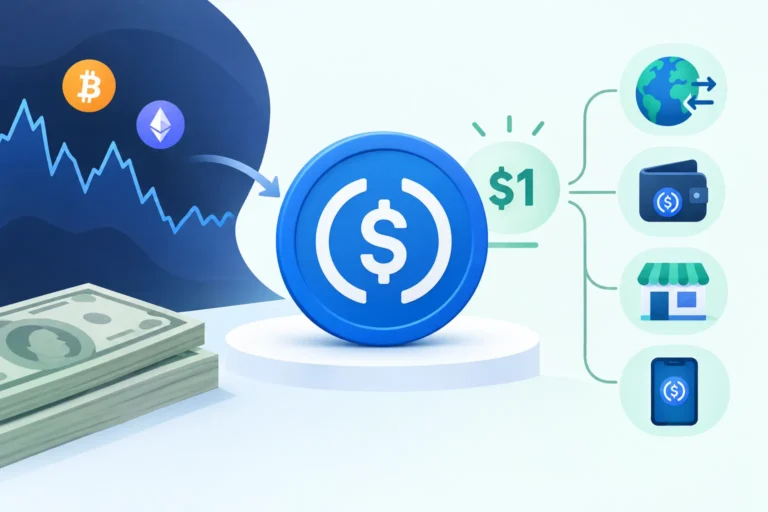
If you’ve spent any time around crypto, you’ve probably heard someone say they “moved into stablecoins.” It sounds like jargon. It isn’t, really.
what A stablecoin is a cryptocurrency designed to track the value of something steady — usually the US dollar. One token is meant to be worth about one dollar, today and next Tuesday and next year.
That’s the whole idea. But how a token holds that value is the part worth understanding, because not all of them do it the same way, and none of them do it by magic.
The problem stablecoins were built to solve
Crypto prices move. Sometimes a lot. Bitcoin has dropped sharply over a few weeks and climbed back months later, and if you’ve watched your wallet through one of those stretches, you know how it feels. We covered the why in our guide to crypto volatility.
Volatility isn’t automatically bad. But it makes some things hard.
Say you want to send money to family overseas. Crypto rails can do that quickly and cheaply. But if the coin you send drops 8% between when you hit send and when they cash out, you’ve got a problem. Same if you’re a small business taking crypto payment, or someone who just wants to park value somewhere without watching the number swing every day.
People needed a crypto asset that behaved like a dollar. That’s the gap stablecoins fill.
How a dollar-pegged token actually works
A stablecoin lives on a blockchain, which is the shared digital ledger that records who owns what. (If that’s new, start with what a blockchain is.) It’s a token, not a coin with its own network — a distinction we break down in coins vs. tokens.
The most common type is called fiat-backed. Here’s the mechanical version:
- Somebody puts dollars in. A company called an issuer takes in real US dollars from customers.
- The issuer creates tokens. For every dollar received, one token gets created — “minted” — and sent to the customer’s wallet.
- The dollars sit in reserve. Those dollars don’t get spent. They’re held in reserve assets, typically cash at banks and short-term US government debt, kept separate from the company’s own money.
- Tokens can be turned back in. Customers can hand tokens back to the issuer and get dollars out. The tokens are then destroyed, or “burned.”
That last step is what actually holds the peg. If the token ever trades below a dollar on the open market, buyers have a reason to scoop it up cheap and redeem it at full value. That buying pressure pushes the price back up. The promise of redemption is the anchor.
Some stablecoins work differently — backed by other crypto, or by code alone with no reserves behind them. Those designs have a rockier history. When you hear “stablecoin” in everyday use, people usually mean the fiat-backed kind.
USDC, in short
USDC is a dollar-pegged stablecoin issued by Circle, a US financial technology company. It launched in 2018 and now runs on a long list of blockchain networks.
Circle publishes information about what backs USDC on its transparency page, including regular third-party reports from a major accounting firm. Those reports are attestations, not full audits — an important difference. An attestation confirms what the reserves held on a specific date. It doesn’t review the company’s internal controls or its history.
Circle also holds money transmitter licenses in the US and operates under federal stablecoin rules established by the GENIUS Act, signed in July 2025. That framework sets requirements around reserves, redemption, and disclosure for large issuers.
If you want to check the details yourself rather than take anyone’s word for it, Circle’s transparency page is the place to look.
What people use stablecoins for
Sending money. Moving dollars across borders through traditional channels can be slow and expensive. A stablecoin transfer settles in minutes on most networks, and the amount that arrives is the amount you sent. Network fees vary a lot depending on the blockchain, though — some are pennies, others aren’t.
Sitting still. Some people hold stablecoins between other moves, so they’re not exposed to the price swings of Bitcoin or other assets while they decide what to do.
Paying and getting paid. Freelancers, contractors, and small businesses working with clients in other countries sometimes settle in stablecoins because it’s faster than a wire and the amount is predictable.
Getting into crypto without the rollercoaster. For someone curious about how crypto works but uneasy about volatility, a dollar-pegged token is a lower-drama place to start learning.
What “stable” does and doesn’t mean
This part matters, so let’s be direct.
Stable means designed to track a dollar. It does not mean protected, insured, or guaranteed.
Stablecoins are not bank deposits. They are not FDIC-insured. They are not backed by the US government, even though some of them hold US government debt in reserve. Holding a dollar-pegged token is not the same as having a dollar in a bank account, and anyone who tells you otherwise is selling something.
Pegs can break. In March 2023, USDC briefly traded below a dollar after it came out that some of its reserves were held at Silicon Valley Bank, which had just failed. The price recovered within a few days, and Circle later restructured where reserves are held. But it happened. A peg is a design goal, not a law of physics.
You’re trusting an issuer. With a fiat-backed stablecoin, the value depends on a company actually holding the reserves it says it holds and honoring redemptions. Disclosure and regulation reduce that risk. They don’t erase it.
Stablecoins don’t earn anything by sitting there. A dollar-pegged token in your wallet is worth about a dollar. That’s the point, and also the limit.
None of this is a reason to avoid stablecoins. It’s a reason to understand what you’re holding.
Stablecoins on Coinme
You can buy and hold USDC in the Coinme app alongside Bitcoin, Ethereum, and other assets, all in the same wallet.
Buy with Debit lets you purchase USDC directly in the app with your debit card. Buy Crypto Now.
You can also send and receive USDC on the Stellar network from your Coinme Wallet, which we launched back in 2023 to make transfers faster and cheaper than they’d be on some other networks.
Prefer cash? Coinme Cash lets you load your Coinme Wallet with cash at the checkout counter at participating retail locations. You’ll pay a cash exchange fee at the register. Funds arrive in your Coinme Wallet within 15 minutes. Find a Location.
Stablecoins aren’t a magic trick or a shortcut. They’re a tool — a way to hold and move dollars on a blockchain. Now you know how the tool works.
Explore what's available in the Coinme app
Download the Coinme app
Find your way to get a stablecoin